Azerbaijan
Azerbaijan
I arrived at Heydar Aliyev airport in Baku at 7pm and watched 75 year old Yuri scampering off for his connecting flight to Moscow. If I lived in Moscow Yuri and I would be friends. Inside and outside of the airport were young volunteers wearing turquoise tracksuits helping hapless tourists like me. Uber was malfunctioning so I asked a young man for assistance and he was brilliant, booking me a car and delivering me to my first ride in a BYD. I tried to tip him but he refused. Against the rules apparently.
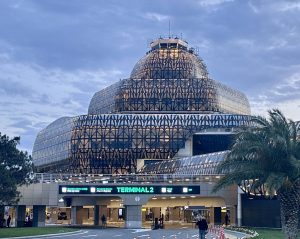
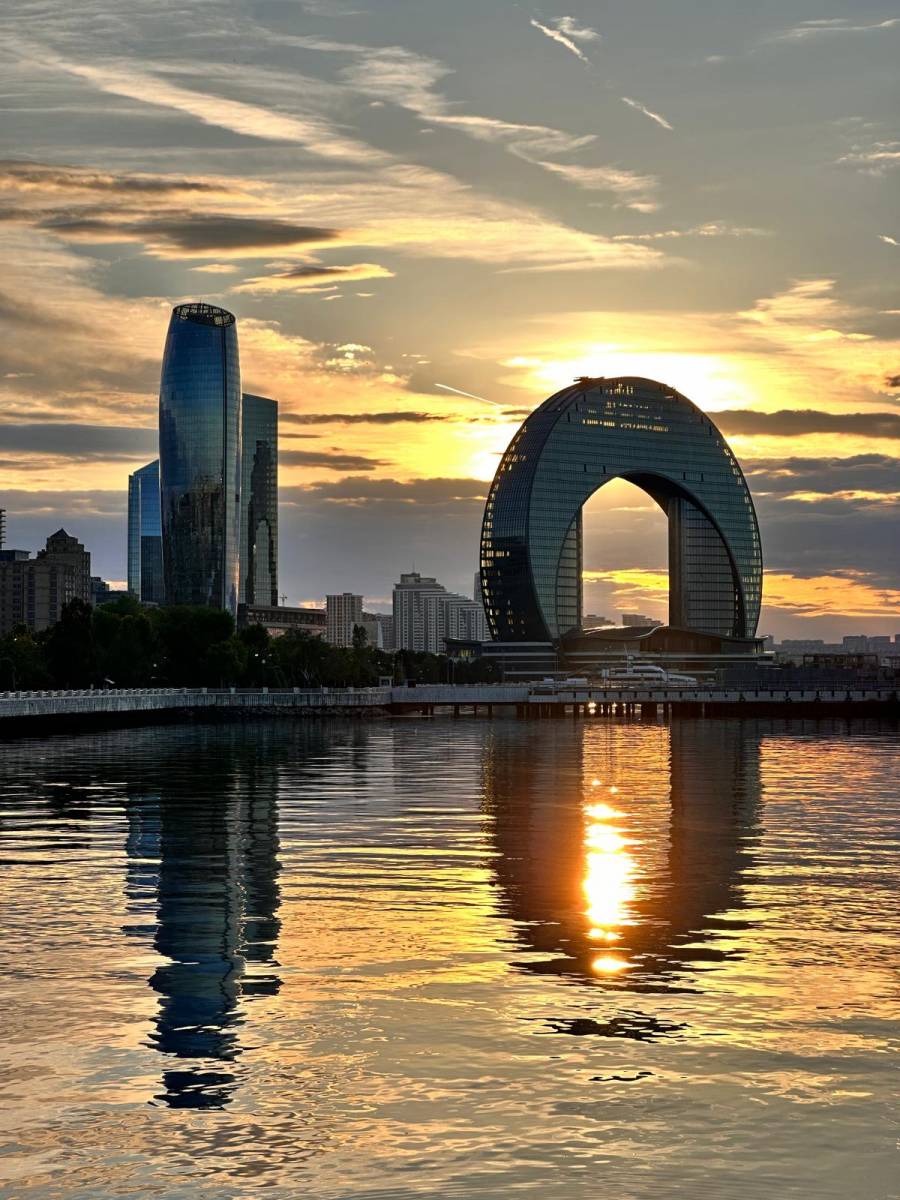
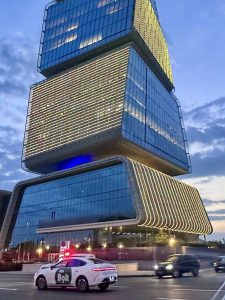
30 minutes later I was at the three star Ibis hotel. Functional is all I can say. I did have a view of the Caspian Sea though which none of the other places I’ve stayed could match. On the way in I was struck by how modern some of the architecture was. Almost Dubai modern.
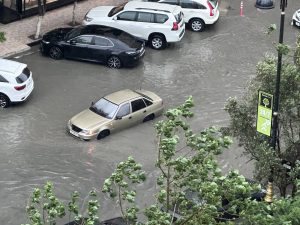
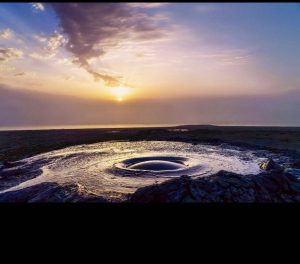
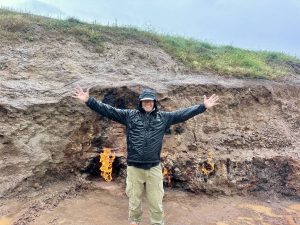
On Sunday we headed off with our local guide, Zara. Ovaline with great eyebrows. It was raining and the roads were flooded. There were seven of us on the trip from all over the place. We drove for about 90 minutes to Gobustan to see the world famous mud volcanoes that none of us had heard of. Azerbaijan is the undisputed king of mud volcanoes where tepid mud starts to bubble up. We didn’t see any bubbling or anything that resembled a volcano. It was a bleak place and very wet. Below is what we saw versus what we could have seen.
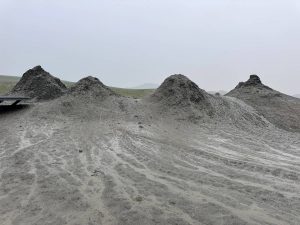
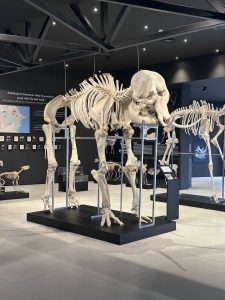
Next door in this desolate place in the middle of nowhere was a skeleton museum which was mildly interesting.
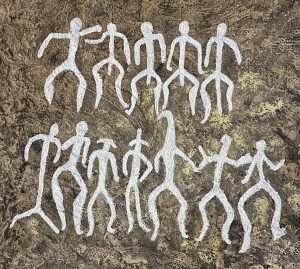
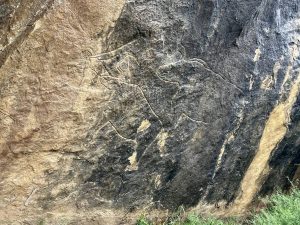
Gobustan is also home to rock art in the form of around 6,000 petroglyphs stretching back thousands of years through the various ages. I didn’t see many carvings on the rocks themselves however the museum contained more recognisable representations. Anyway, what I can say is that artistic talent wasn’t abundant back then.
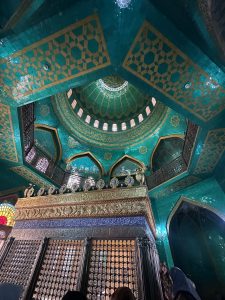
Next up on our journey of discovery was a small coastal mosque. 97% of Azerbaijanis identify as Muslim. Most are Shia but there is still a significant minority of Sunni.
Back in the fun bus somewhat damp, we headed for lunch in a fabulous restaurant serenaded by a chap playing an accordion. Next door was the Hindu Fire Temple where flames would spontaneously seep from the ground. I guess religious types thought this was some kind of sign rather than a geological phenomenon, so they built a temple.
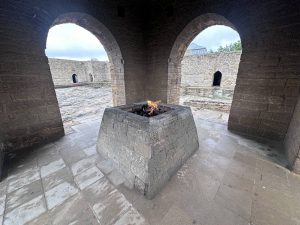
Our final stop was Yanar Dagh meaning “burning mountain” which is a fire that burns perpetually on a hillside on the Absheron Peninsula. Similar to the one I saw in Turkmenistan last year at Darvaza, the other side of the Caspian Sea. Only this one was smaller and less impressive. Having said that, we could get close to it, like 3ft away, which we all did to dry off a bit.
Azerbaijan means “land of fire” and it’s officially part of Asia. It’s also considered Eurasian and also in a region known as the Caucuses along with Georgia and Armenia. Baku is the capital and is the lowest in the world – 28m or 92 feet below sea level. I must admit, I did think the plane took a little longer to land. Azerbaijan holds the record as the first country to drill for oil in 1846, some 13 years before the USA in Pennsylvania. This discovery made some early oil barons some of the wealthiest people in the Russian Empire. Azerbaijan became part of the Russian Empire in the first half of the 19th century.
Azerbaijan has an 800 km coastline on the Caspian Sea. Four other countries also have a Caspian coastline – Iran, Russia, Kazakhstan and Turkmenistan. The largest river flowing into the Caspian Sea is the Volga, Europe’s longest river which accounts for about 80% of its inflow. There are no natural outlets making the Caspian Sea a terminal lake.
Azerbaijan declared independence from the Soviet Union in 1991. The first two presidents only lasted a year each before Heydar Aliyev took office. He lasted ten years and was a former member of the Politburo and a KGB general in Azerbaijan. When he died in 2003 (in Cleveland, Ohio) his son took over. Ilham Aliyev has now been there for 23 years and he established the role of vice-president (which hadn’t existed before) and gave it to his wife, Mehriban. Their two daughters also hold positions of “soft power” – cultural etc. making the family highly influential. As well as nepotism, there are also longstanding allegations of corruption including one case called the “Azerbaijani Laundromat”. But you didn’t hear this from me! On the Freedom House index, Azerbaijan scores a low 6/100. Ireland is the highest with a score of 98/100.
The population of Azerbaijan is around 10 million with around 2 million in Baku. Traffic has become one of the biggest quality of life issues in recent years. The country is a little smaller than the US state of South Carolina. One geographical anomaly is the enclave of Nakhchivan which is separated from the rest of Azerbaijan. In order to get there one has to drive via Armenia. In August 2025 the US brokered a deal to connect Nakhchivan to Azerbaijan via a 42 km road a rail corridor. Known as the Trump Road its official name is the Trump route for International Peace and Prosperity (TRIPP). He gets everywhere.
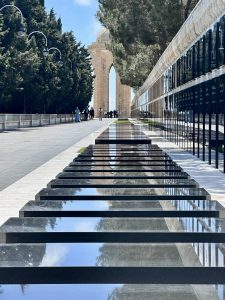
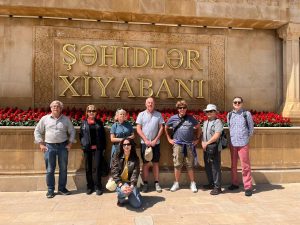
Monday was a much nicer day with blue skies and sunshine quite a contrast from the flooding the day before. I was very pleased with the climate change. We went off in the bus for a tour of Baku. First up was Highland Park which had a memorial named Martyr’s Lane dedicated to those who died on the 20th of January 1990 when the Soviet Union sent the tanks in and shots hundreds of civilians in the streets. 147 were killed with over 700 injured. It swung public opinion against the Soviet Union and a year later Azerbaijan declared independence.
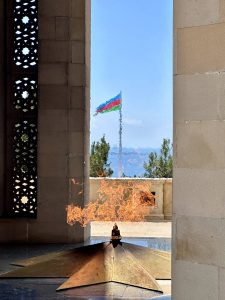
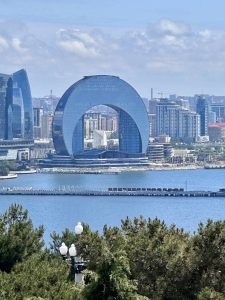
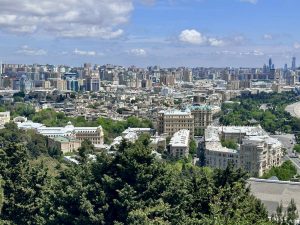
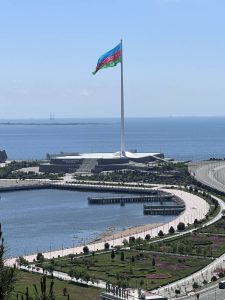
From the park we had great views over the city including a new hotel being built – the Crescent Hotel, and flag square which has the largest flag in the world at the top of a flagpole (best place for a flag). It measures 70m by 35m which would cover most of a football pitch.
Next up was a carpet museum which as you can imagine thrilled me. I chose to visit the adjacent shopping mall instead which was reminiscent of Sydney Opera House. It turns out that Azerbaijan is one of the carpet capitals of the world. It’s not just an industry but more a cultural skill passed down to young girls. When searching for a wife, forget whether she can cook or not. Can she prepare wool and what’s her knotting technique like.
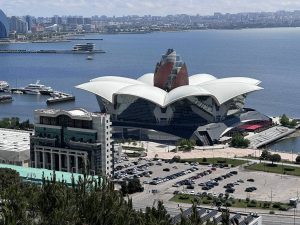
The mall didn’t have that many stores but the ones there were all high-end for a country of predominantly low-end people. The average salary per month is around $650.
After missing out on the carpet experience we headed to the Old City which was surrounded by high walls. Other than a Lamborghini with Russian plates slipping by us on the cobbled streets, we could have been in mediaeval Persia during the Silk Road era. It covers an area of 22 hectares which doesn’t mean much to people so for comparison purposes it’s about 30 football fields or 825 tennis courts. Today around 3,000 still live inside the city walls.
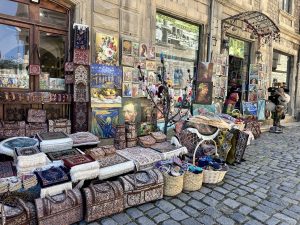
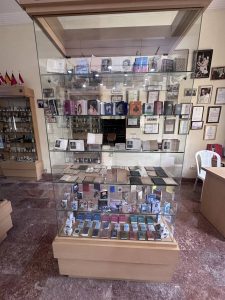
It was a fabulous place to walk around and we did a circuit of all the main parts including the Museum of Miniature Books which had between 5,600 – 8,000 little books. Some were hardly visible with the naked eye.
The highlight was the Maiden Tower which some of us climbed. It wasn’t particularly difficult and the views weren’t particularly good primarily because of the massive glass sheets three feet from the wall’s edge. The walls were quite low and they might have had a problem with people tossing themselves off.
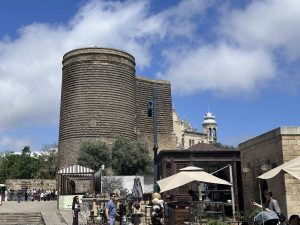
I declined dining with the group and headed out for a walk instead. One thing I did notice in Baku was the massive police presence. Almost every major street corner or intersection had three or four standing around. It certainly felt safe walking around at night.
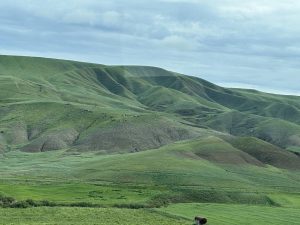
After two days in and around Baku we left the Ibis hotel heading northwest to the northeast part of Azerbaijan. I know that sounds peculiar. We had a long day of driving ahead of us with a few well-chosen stops along the way. Within an hour we were heading into the mountains with lush greenery all around. Our first stop was the historically significant Shamakhi which was established over 2,000 years ago and was also a stop on the Silk Road.
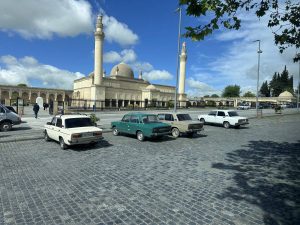
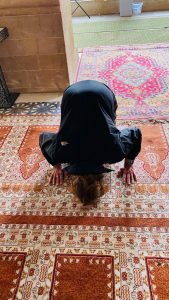
First stop was the Juma mosque built in the 8th century. We had it to ourselves and it was typically mosque-like with a vast cavernous areas for prayer. The carpet was designed with individual player positions and I tried one with a flat stone on which to lay my forehead. Felt quite nice. The stone is called a Turbah or Mohr (two good scrabble words), and it is practised by Shia Muslims only.
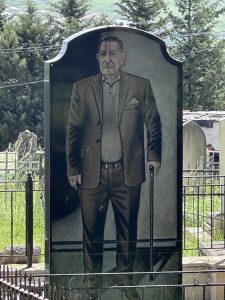
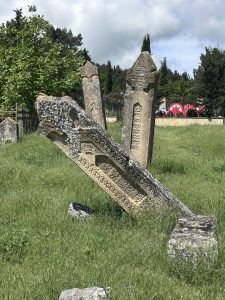
Next up was the Yeddi Gumbez Muslim cemetery. I know. The first time a guide has taken us to one. A tour leader after my own heart. Fenced off plots for entire families was a theme. Also, many had images of the person on the smooth black marble. And, I’ve never seen such crooked headstones before. Lots of them. All cemeteries in Azerbaijan are segregated by religion.
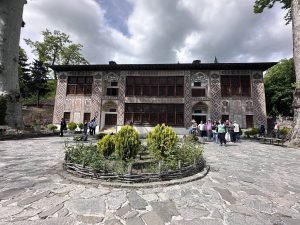
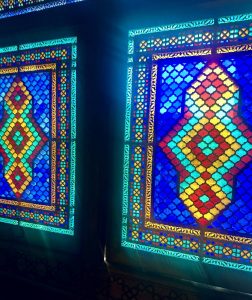
After a stopping for lunch in a traditional Azerbaijani restaurant we headed for the Sheki Khan’s Palace. I think the world “palace” sets expectations a little too high. It was small and highly decorative but none of it really fit together. Every window was comprised of hundreds of pieces of coloured glass. Still, it killed an hour before heading to our hotel.
The Minali Boutique Hotel was a little tragic. Personally I think there should be strict rules as to when you can use the word “boutique” to describe a lodging establishment. I was one of the lucky ones with what he described as a “deluxe” room.
There was no bar or restaurant and no facilities that would encourage remaining in the hotel so I headed for town and found a nice outdoor bar and had a beer.
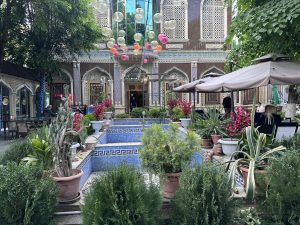
The bar was next to a mosque and the call to prayer was one of the more melodic I’ve heard.
We left early and headed for the Georgian border some two hours away. The scenery was pleasant especially the snow-capped mountains. Other than a group of Chinese who turned up after us, there was no one at the border crossing. We said goodbye to Zara and our driver and walked over no man’s land into Georgia.

Related Posts