Georgia
The border crossing was relatively painless and we were met the other side by our new guide, Maria. I left Azerbaijan on the UK passport and entered Georgia on the Irish one. Only one page left in the UK passport with two years left to run on it.
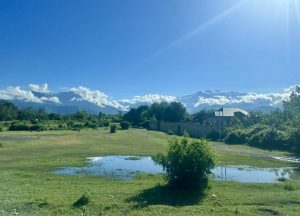
We boarded the fun bus and headed for the town of Sighnaghi 90 minutes away. It’s known locally as the city of love because there’s a place where you can get married open 24 hours a day. Our first stop was for wine tasting. Georgia is famous for wine and regarded as the first country to produce grape wine – the “cradle of wine” with over 8,000 years of viticulture. We sat around a small low table while the wine man scooped wine from a hole in the ground called a qvevri. It didn’t look particularly hygienic. One white, two red and a dessert wine followed by a shot of fire water (44%). The white was passable but the others were less so. We all had to pick our favourite – best of a bad bunch type vote.
All feeling slightly squiffy, we went on a city tour and Maria told us the story of Georgia’s most famous artist, Nico Pirosmani. He was born into poverty and legend has in that when a beautiful French dancer named Margarita de Sevre came to town in 1909 he became captivated by her. He sold his house and bought hundreds, maybe thousands, (possibly a million), roses and spread them outside her hotel room. She was touched by the gesture and gave him a kiss, but couldn’t possibly entertain a relationship with a man without a house. It’s the point where romance and stupidity intersect.
She returned to Paris with a wealthier suitor and Nico was inconsolable. He started drinking and died aged 55 during the 1918 Spanish flu epidemic. In the 1960’s an elderly Margarita visited an exhibition of his paintings in Paris and was overcome by emotion. She wept, supposedly because of his intense unrequited feelings for her expressed through his art. I think she may have wept for a different reason. You decide.
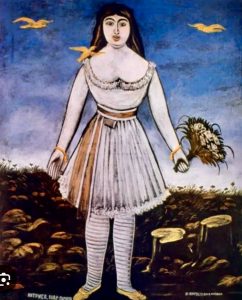
He made no money from his paintings whilst alive but they now sell for up to $2 million.
We had lunch outdoors with commanding views of the Alazani valley below. The best part of Sighnaghi came next where we were able to walk the walls of the fortress.
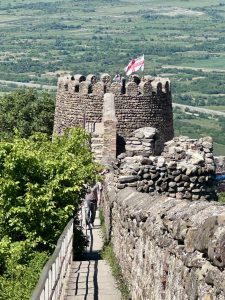
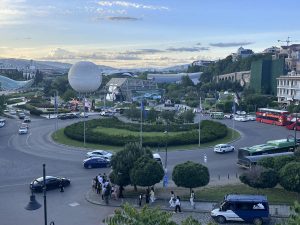
We pressed on to Tbilisi which is the capital of Georgia. We checked into another hotel with little in the way of facilities, but the room was an improvement on my “deluxe” room and we were near the old town for our three night stay. I’m never sure whether I should capitalise Old Town or not so I’ll mix and match.
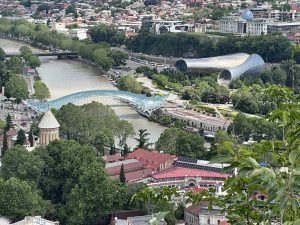
I ventured out toward the old town and noticed how hilly Tbilisi was. Well, my legs noticed it first and informed me. I liked it immediately and the natural topography added hugely to its attractiveness. I had a glass of Georgian wine overlooking the Kura River – one of the dirtiest looking rivers I’ve seen since the Ganges. In fact all of the rivers I’ve seen in the caucuses have been a similar mud colour.
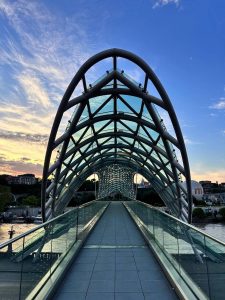
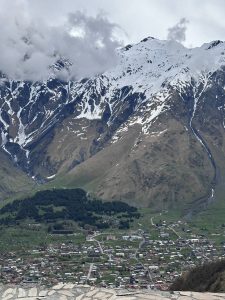
On Thursday we headed out on a long day in the bus. I settled into my seat which was probably designed for a child’s buttocks and watched the scenery as we left the city and headed north into the Caucus Mountains. It wasn’t long before we were greeted by snow-capped mountains as we reached higher altitude.
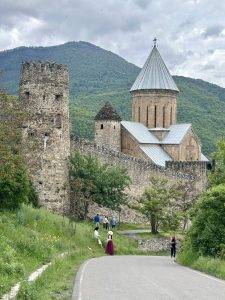
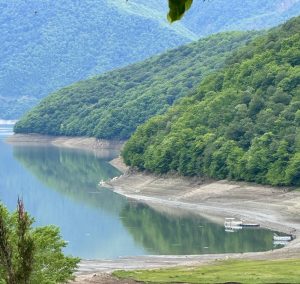
About 90 minutes in we stopped at a fort/ church place called the Ananuri Fortified Castle Ensmble. It was located on the Zhinvali reservoir which dams the Aragvi river. We were soon joined by a coach load of Chinese tourists. The same ones who had been following us for days.
We pressed on for a quick lunch stop in a supermarket near the ski resort of Gudauri. It was a scruffy place and I made the mistake of imparting this determination to the guide. I think she was a little offended and I’ll have to make it up to her. England has lots of scruffy too. Scruff is everywhere.
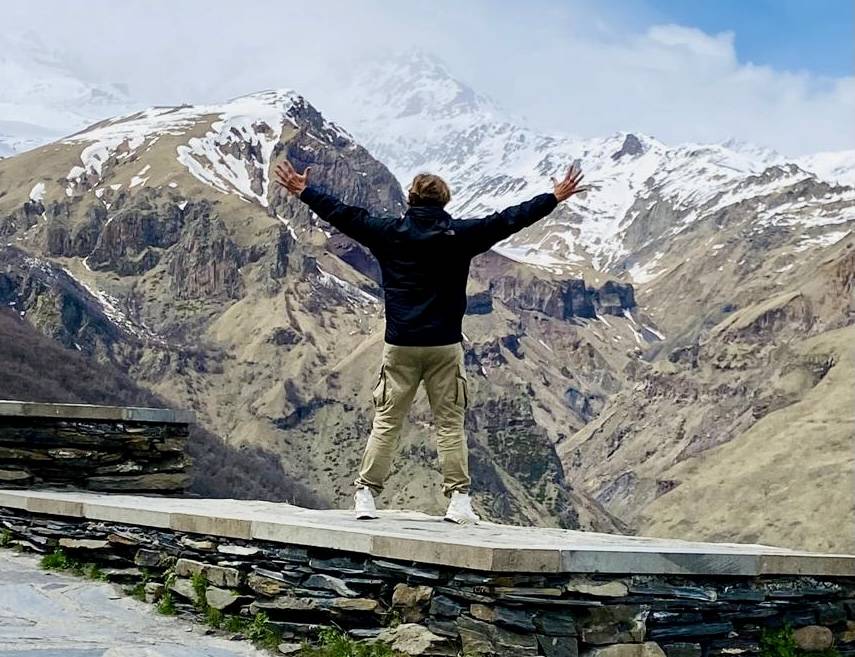
We carried on into the mountains and reached a pass of 8,000 ft before descending slightly and reaching a monastery. We swapped vehicles and 4×4’s took us up a winding road to the top of a mountain where the Gergeti Trinity Church was located. Ten monks still live there. The views were magnificent.
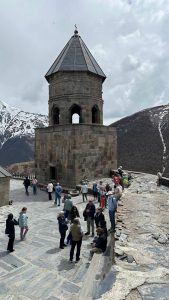
We were on the highway that led to Russia and the monastery was only 18km from the border. Trucks were passing in both directions and the roads become quite hazardous during the winter months. The Chinese are building a 9km tunnel that will bypass the highest elevations and save around 45 minutes.
We headed back to Tbilisi with one more sight to see which was a monument along the same road we came in on. When we got there the heavens opened and only one brave soul, Peter from Canada, made the 200m walk to the monument. He shared his photo with the group. He literally took one for the team.
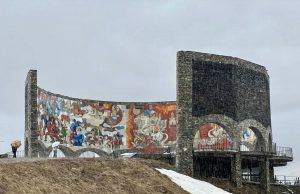
Then it was two hours back to Tbilisi and a glass of vino overlooking the Kura River before Netflix called. I have to say that today’s excursions were not worth the time taken to see them (and I rarely say that). I guess the saving grace was the scenery there and back which was relatively impressive.
Georgia has a population of around 4.5 million excluding Abkhazia and South Ossetia. Where are those places you may ask. Both are Russian-backed breakaway states however most of the international community consider them to be part of Georgia.
It’s 84% Orthodox Christian. Not including Russia, of the 14 countries established as a result of the dissolution of the Soviet Union, six are Muslim, whilst the other 8 are Christian with Lithuania the only one which is Roman Catholic by majority. The Georgian alphabet is unlike any other in the world with one case (no upper or lower difference). There are 33 letters. As well as the Black Sea, Georgia shares a border with Russia, Turkey, Azerbaijan and Armenia. The currency is the lari and one lari is split into 100 tetri. The monthly pension is around 120 euros and women retire at 60, men at 65.
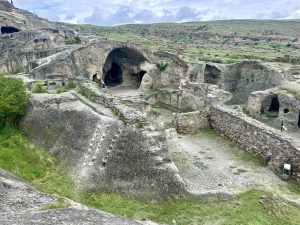
On Friday morning we set off to visit the oldest settlement in Georgia, Uplistsikhe which translates to “the Lord’s Fortress” and is a cave city carved into the sandstone rock on a cliffside overlooking the Mtkvari River. Yes, four unusually grouped consonants in a row. We walked up steps and clambered over the smooth rocks and had a good look around this 3,000 year old urban complex. A good workout and an enjoyable excursion.
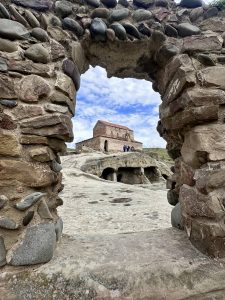
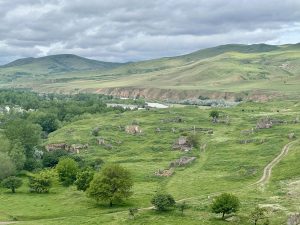
Twenty minutes back in the direction of Tbilisi was the highlight of the trip for me. The Joseph Stalin museum. Stalin was born in 1878 in Gori, Georgia which was then part of the Russian Empire. He was born into poverty – his father was a shoemaker and his mother a washerwoman. His birth name was Iosif Dzhugashvili but nobody could spell it so he adopted “Stalin” meaning “man of steel”. Ironically his mother wanted him to be a priest – a man of peace and religion, but he ended up being the second most murderous dictator in history. He was expelled from the seminary and became interested in Marxism in the late 1890’s. He was arrested several times and on six occasions sent to Siberia where he escaped 5 times. After the Russian Revolution in 1917 he steadily rose up the ranks and when Lenin died in 1924 he outmanoeuvred others including Trotsky to seize control. Trotsky was expelled in 1929 and became the most outspoken critic of Stalin. He was assassinated in 1940 in Mexico City by a Soviet agent sent by Stalin. Stalin, who was only 5”4’ remained in power until his death in 1953.
The museum was located next to the house where he grew up. Our museum guide whisked us around the various rooms at speed and I have to say it was one of the better museums I’ve visited. Outside was the train carriage he used to travel around in which took him to the various conferences including Yalta. The train was basic and even his private quarters were a far cry from a Premier Inn/ Motel 6.
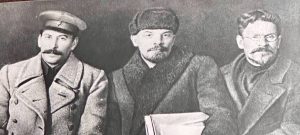
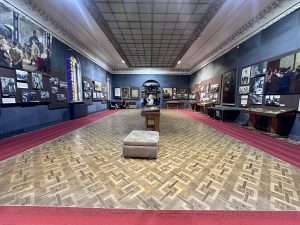
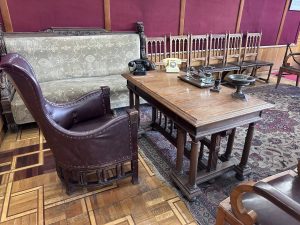
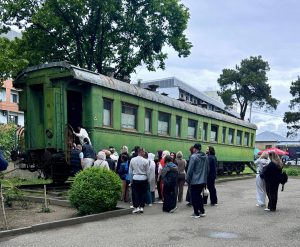
People in Gori are divided in their views of “Uncle Joe” Stalin. The older generation regard him as a hero – a local boy who did well and who achieved a great deal for the Soviet Union. The younger generation, not so much.
We got back to Tbilisi relatively early and I headed for one of the many churches in the city. I chose the biggest most impressive church which was actually the Holy Trinity Cathedral. It’s one of the biggest Orthodox churches in the world and was only completed in 2004. One thing I’ve noted about Orthodox churches is the lack of seating. Services are mostly done standing and people gather around icons – Christ, the Virgin Mary, Patron Saints, which are arranged on the walls and on columns within the church. Worshippers are not focused on one central person, but instead facing in all directions. It’s actually quite disconcerting. He’s looking that way, she’s looking another way, and as for them over there.
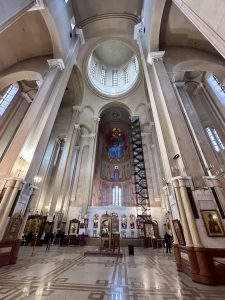
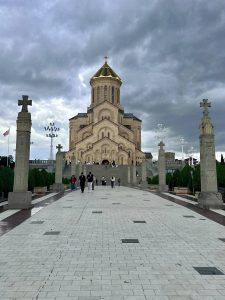
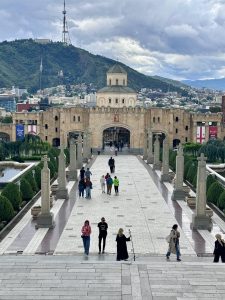
The evening rain was quite dramatic but armed with an umbrella I was able to find a dining venue overlooking the swollen Kura River.
On Saturday morning we embarked on a three hour walking tour of Tbilisi. We’d seen a little already in our free time. We crossed the Metekhi Bridge to the old town which was delightful with a waterfall at the far end.
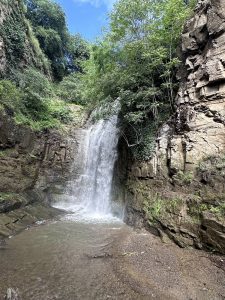
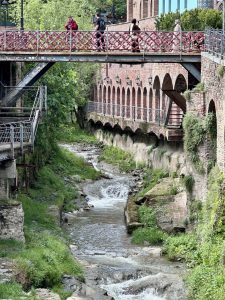
Then an underground walkway to get to the other side of the street which had been turned into a bazaar and it was terrific. Then a ride on the cable car providing great city views.
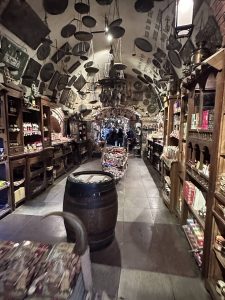
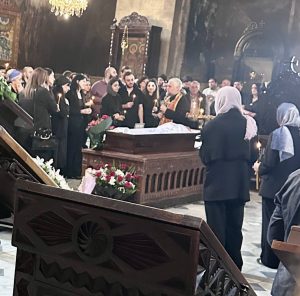
Then a walk through more old town where we visited the oldest church in Tbilisi – Sioni Cathedral, dating back to the 5th century. The highlight of this one was that there was a funeral going on and the poor dead chap was in an open coffin in the middle of the church. I’ve not been a spectator/ tourist at a funeral before. Quite the experience.
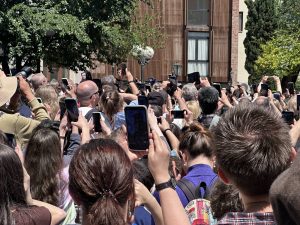
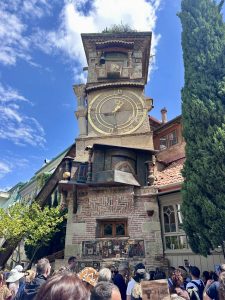
Then our guide said something very disturbing. We were going to a puppet show. I wasn’t sure I could handle it but I went along. It was outdoor and hundreds had gathered to see the 12pm performance of the twice daily marionette show. Phones ready at midday on the dot a little door opened on a tower and some puppet figures were seen going around. It lasted exactly 1 minute. That was it. Finished. And the gathered crowd slowly dispersed. I’m not sure I’ve experienced anything quite insane in a long time. Grown adults most of them. Underwhelming took on a whole new meaning. Having said that I’m glad it didn’t last for say, 15 minutes.
Lunch was pleasant with a super waiter before driving 2 hours to the Armenian border. We lost Maria, our guide, but retained the driver. The crossing was easy enough. Relations are good between Georgia and Armenia. Not so between Armenia and Azerbaijan.
Next stop Armenia.

Related Posts