Algeria – A Land Untouched by Modern Dentistry
I have recently returned from a 9 day trip around Algeria with 15 other curious misfit adventurers. Algeria is a little off the beaten track and not on everyone’s bucket list, but in recent years this North African nation has seen a surge in tourism reaching around 2.5 million visitors annually.

My visa on arrival cost 135 euros which was a little steep however some of my fellow travellers who were booked on the extended 15 day tour were charged 335 euros. It made no sense that 6 extra days cost an additional 200 euros.
The drive to the hotel through Algiers city centre was most architecturally impressive. Explore had put us up in a five star hotel which is unusual. I didn’t complain.
On Sunday, the first day of the working week in Muslim countries, we headed west along the coast to see some stuff. A mausoleum shaped like a panettone containing the Berber King, Juba II and Cleopatra Selene, the daughter of Cleopatra and Mark Antony. We couldn’t go inside so we walked around the circular structure. Next was a museum in the rather attractive coastal town of Cherchell. It was stuffed with statues with various body parts missing. One statue was just a pair of legs from the knee down…and they still managed to identify the owner of the legs.


The highlight of the day was the coastal Punic trading post of Tipasa founded in the 6th century BC. This was the first of 6 UNESCO sites we would see. Apparently there were influences from the Phoenicians, Romans, Christians and Byzantines. If you know what to look for that is. Roman Emperor Claudius took it over in the 1st century AD.


Our transport for the week was predominantly a large 30 seater bus, almost always with a police escort, however on this evening we were flying 600km south to Ghardaia with Air Algerie on a 72 seat propeller plane. We were flying to the M’Zab Valley on the edge of the Sahara and apparently prop planes are better at dealing with sand and hot desert conditions than jets. Algerian airports have lots of security checks but nobody seems to take any notice. Rambo could have walked through. I had the briefest pat-down in history. Facilities airside were underwhelming. A single cafe and a toy shop. The flight was smooth and 75 minutes later we arrived.
Ghardaia was an interesting place to explore. There was a large open square connecting a labyrinth of side streets both residential and retail. You could buy anything from an Obi-Wan Kenobi outfit, to knock-off Nike trainers, to a camel’s head. A guide turned up and took us on a “death by detail” tour. I really want to explore these places at my own pace. I’m okay with the highlights but guides are normally employed for at least an hour which means lots of unnecessary detail. It was when he said, “Now let me tell you about the drainage system”, that I finally cracked. I’ve visited many similar places over the years and not once has my curiosity been piqued by the drainage system.

Ghardaia is home to the Mozabite community. Married women wear a white burnous with only one eye showing. I think they get to choose which eye. Unmarried women, on the other hand, can expose both eyes and wear different colour outfits.

As with many Muslim countries men can have up to four wives. If this was widely practised there would obviously be a high percentage of single men – if Mohammed had four wives Abdul, Ahmed, and Ali would have none. See how this works. However, Algerian men, like their counterparts the world over, realise that one wife is plenty (often more than enough).
After two nights in the rather pleasant Ghardaia, we had two long days in the bus staying at M’Sila and Batna – two cities I don’t need to return to. In M’Sila we dined as a group and for a moment I thought my meal cost 15p. It turns out that they leave a zero off their prices which meant it was actually one pound 54 pence. Rip off!
On the way to Batna we visited our second UNESCO site and we were the only ones there. Beni Hammad Fort was the least spectacular of the six UNESCO sites we visited.

After a second long day in the bus we finally arrived in Batna early evening. It was another dry hotel so I availed myself to the wine box I’d brought with me (I should have brought two).
We left Batna on Thursday and headed for the Roman ruins of Timgad North Africa’s Pompeii. Once again we were the only visitors and I walked around at my own pace having a super time despite the wind. The sun finally emerged making it a very pleasant morning.


We pressed on with a fairly long drive to the city of Constantine for a two night stay at a Novotel. Upon arrival we explored the city on foot before checking in and all I can say is WOW! If Constantine was a European city it would be hailed as one of the most picturesque. The city boasts seven bridges spanning a large gorge with the rather small Rhumel River at the bottom. Absolutely splendid city. We visited the WWI memorial followed by a ride on the new cable car for 16p.

The Novotel had a bar however the Algerian wine was expensive and awful. I should have stuck to Heineken. Many things were cheap in Algeria – petrol is some of the cheapest in the world, and dining out is highly affordable. What’s wasn’t cheap – alcohol and dining in the hotel.
On Friday we went on a walking tour of Constantine and first up was the Palace of Ahmed Bey where the last bey lived at the end of Ottoman rule. A bey is equivalent to a governor and it was a rather nice pad.

Next we walked across a footbridge with spectacular views. Quintin doesn’t like heights and steamed across the bridge at top walking speed. After that was another museum – more pots, mosaics, utensils. I chose to walk around instead.

We walked to our lunch spot and I experienced one of the highlights of the trip. It was a traditional restaurant with low seating. We had the place to ourselves with the exception of two small tables at the end that were reserved for another group. Within a minute of arriving Scouser Dave sat on a three legged stool, and went flying, arms flailing. He completely destroyed the two tables smashing all the glasses. It was hilarious. He didn’t have far to fall so wasn’t injured. At that point I decided to go back to the hotel. Lunch for 16 can take a while and now there was a clean-up job before the other guests arrived. The only thing that would have made it funnier is if the other guests had already arrived and had been heading for their reserved tables when Dave went flying. I had the giggles all the way back to the hotel.
Mid-afternoon most of us went on an optional trip to Tiddis which was another Roman ruin. At 50 euros each it was a little steep and the money went to our guide, Rochdi, and the driver, Omar. They did very well for a four hour round trip. The entry fee was 1 euro! It was a modest site on a hillside surrounded by verdant countryside and the climb to the top was good exercise. This was the only UNESCO site where we encountered other visitors.

On Saturday we left Constantine and headed for Setif via the spectacular UNESCO site of Djemila, another Roman ruin founded by Emperor Nerva. This was the best one of the lot, regarded as one of the most preserved Roman towns in North Africa. Once again I explored on my own and had a wonderful time. The backdrop of green hills made it particularly stunning.


We pressed on to Setif where we had a hotel in the centre of town. It was the weekend and the streets were heaving. I checked in ahead of the others hoping to miss some of the museum tour. Alas I did not. This was a much shorter guided tour which suited me fine.
Sunday we headed back to Algiers and first visited the impressive Memorial to the Martyrs. It was perched on a hill overlooking the Mediterranean adding to its appeal. The memorial was built to commemorate those who died in the Algerian War of Independence against the French (1954-1962).

After a lovely lunch at Nadia’s restaurant we went walking to see some of the best sights. Then the bus took us to Notre Dame D’Afrique which looked more impressive from the outside, before the Casbah which was a little disappointing.


The group was splitting up now. Seven of us heading back to the same hotel we stayed at on the first night, the other 9 off to the airport for their late flight to the Sahara for 6 nights. I wished I was going with them.
When Sudan split into two in 2011 Algeria became the largest country in Africa. The population is around 47 million and the vast majority live in the north. 90% of the country is uninhabited – the Sahara Desert. Algeria gained independence from France on July 5th 1962 after an 8 year war. The Frenchies seized Algiers from the Ottomans in 1830 and it became part of their empire. As a result French is widely spoken and the architecture in Algiers reflects a heavy European influence. 99% of Algerians are Muslim (Sunni). Worldwide Sunni Muslims outnumber Shia Muslims (85%/ 15%) and the split started all the way back in the year 632 BC when the prophet Mohammed died and they disagreed on who should replace him as head honcho.
The Romans first arrived in modern day Algeria in 146 BC and their rule didn’t end for almost 600 years in 430 AD when the Vandals arrived from Germany. St Augustine was born in Algeria and was a North African Roman. His death in 430 AD coincided with the Vandal siege.
Economically Algeria has some of the largest natural gas reserves in the world however there is still a great deal of poverty with 25% living on less than a dollar a day. Men retire at 60 while women retire at 55.
Algeria borders six other countries and has the longest border with Morocco at 969 miles. The two countries don’t get along and in 1963 became involved in the Sand War. During French colonial times there was a cavalry unit that used camels.
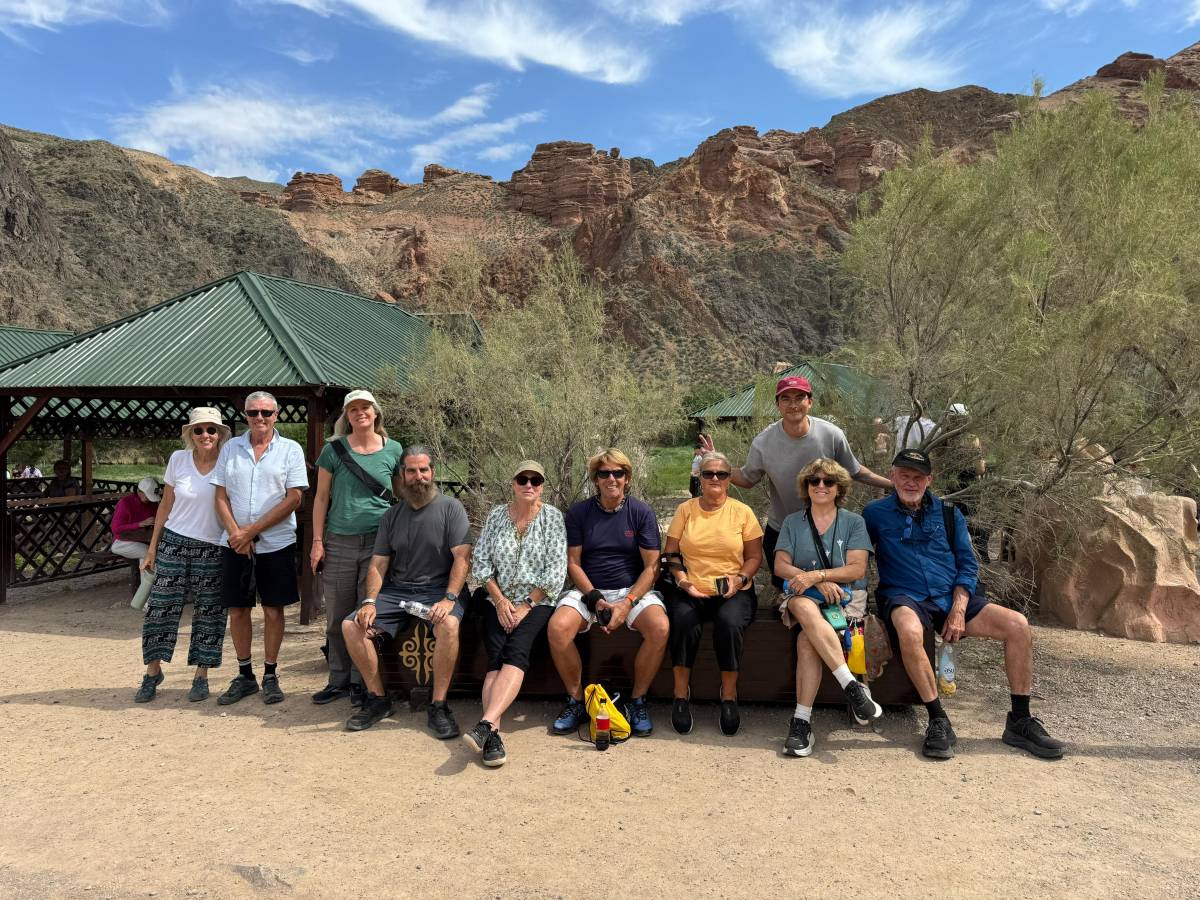
We had 16 in the group – ten male and 6 non-male. One married couple, Wendy and Hugh, one Australian – Sandra from Melbourne, and one Canadian – Helen from Ottawa. The rest were Brits although Anita, my bus Scrabble buddy, lives in Barcelona. As usual they are a well travelled bunch and Scottish Alan had notched up 70 trips with Explore. I thought my 8 trips was a lot!
We had an ex-Vicar called Quintin, Xerxes who has quite the job at the British Museum, a pair of Dave’s, and 79 year old Carol who still has a flip phone and doesn’t have a TV. Sharon was an expert tango dancer and Simon works for the Liberal Democrats in London. We also had Anthony who works for Explore and put this trip together, and the coincidence of the trip was that Kevin used to live in Cedars Road, Beckenham where my friend Simon lives.
Our guide was 28 year old Rochdi who speaks many languages and has a degree in history. He was turned down for a UK visa because he is unmarried and has no children. He was considered a risk. The irony is that Rochdi would be an asset – an educated linguist. Instead we have boat people.
The weather for the week was a mixture of cold, rain, wind, more wind, and every now again a little sunshine. On some days it was colder than London…in Northern Africa! What did surprise me was that we didn’t visit a single mosque other than a tiny one we saw from the outside in Ghardaia. I would visit Algiers and Constantine again and also the Sahara where the rest of the group are now. The photos look amazing

Related Posts